Saturday, May 22, 2021

Sheriff Rosco


"I acted the part, as good as I could.  Rosco, let's face it, was a charmer.  It was a fun thing."
  -- James Best

James Best was born Jewel Franklin Guy in Powderly, Kentucky on July 26, 1926.  When he was three years old, his mother died of tuberculosis and he was sent to live in an orphanage.  He was later adopted by Armen and Essa Best of Corydon, Indiana.

After high school, Best enlisted in the Army and went to serve his country during World War 2.  Although he was trained as a bombardier, he'd spend the majority of his service, ironically, as a law enforcement officer.  He also joined the army unit of actors, which traveled Europe entertaining the troops.  

After the war, Best moved to Hollywood and became a contract player with Universal Studios.  He got his start in a series of western films released in 1950, with such titles as Winchester '73 and Kansas Raiders.  He worked heavily in the genre throughout the 1950s while also appearing in science-fiction films as well.  His most famous of these is the 1959 cult film The Killer Shrews. 

Best also began appearing on television in the 1950s, not surprisingly in westerns.  He appeared on such series as The Lone Ranger and Annie Oakley.  He also had a recurring role on The Andy Griffith Show (right) as Jim Lindsey, a traveling guitar player who would often string a chord with Andy himself.  Best also found himself in The Twilight Zone, appearing in three of the series more popular episodes, each of which had a western theme.  The most famous of these was called "The Last Rites of Jeff Myrtlebank," which found Best waking up in his coffin at his own funeral.  Best worked steadily on television for the next two decades on series such as The Green Hornet, Flipper, and I Spy.  But his most famous role was yet to come.

In 1978, while living in Georgia, Best was asked to audition for a new series entitled The Dukes of Hazzard.  He initially turned it down based solely on the title, believing it to be a "gang thing."  But once he understood the concept and that it would be filmed entirely in Georgia, he signed on to play the sheriff of fictitious Hazzard County, Rosco Coltrane.  

The series debuted as a mid-season replacement in January 1979.  It was an unexpected hit for CBS, who moved quickly to capitalize on the show's success.  In order to save money, the network decided to move production to Warner Brothers Studios in Burbank, California, much to the dismay of Best and his co-stars.  For the next seven years, Best found himself commuting home to Georgia on the weekends, along with his co-star Ben "Cooter" Jones.

But the headaches didn't end there.  Fans of the series will remember that Sheriff Rosco often found himself driving into a lake, falling in wet cement or being doused with cans of paint.  Despite his years of service, Best was not deemed significant enough by producers to warrant his own dressing room, and was not afforded the privacy to shower or clean up after these recurring gags.  He reached his breaking point during the middle of the second season, when he walked off the set and flew home.  Rather than cancel production, producers hired a series of replacement sheriffs, played by such actors as Dick Sargent, James Hampton and Clifton James, a man perpetually typecast as a southern law enforcement officer.  Best's castmates found these actors difficult to work with however, and producers had no choice but to finally meet his demands.  

When production ended in 1985, Best moved to Orlando, where he taught drama at the University of Central Florida.  He took up painting in his spare time and was known for his landscapes.  By the 1990s, he had semi-retired, but Hollywood, or perhaps more specifically Hazzard, wasn't done with him just yet.

Following the death of series actor Sorrell Booke in 1994, the cast re-assembled for production of a TV movie of the week entitled The Dukes of Hazzard: Reunion! (1997).  It was successful enough in the ratings that CBS commissioned a second reunion movie, Hazzard in Hollywood (2000), a film so ridiculous that star John Schneider later described it as "having achieved MAD Magazine status."

With Hazzard now officially in his rearview mirror, Best decided to open his own production studio.  One of the more popular films he produced during this period was a sequel to The Killer Shrews, appropriately titled Return of the Killer Shrews. Best reprised his character in the film, which featured a few other familiar faces from Hazzard County.

By 2015, Best and his wife had retired to Hickory, North Carolina.  It was there that he died of pneumonia on April 6th.  He was 88 years old.

For a few years, Best's final resting place was something of a mystery, as no information was made publicly available.  This blogger finally tracked it down in 2020.  He was buried in Cedar Hill Cemetery in Corydon, Indiana. 

The exact location is somewhat tricky to find.  Your best bet is to use your GPS or find a helpful park employee, as this blogger did. 

Location: Latitude: 38.2166747, Longitude: -86.1223841
Inscription: Remember Me With Laughter

Rest in peace, Sheriff.

Trivia
  • Best released his memoirs in 2009.  You can pick up a copy of Best in Hollywood: The Good, the Bad, and the Beautiful from Amazon.  Fellow blogger and Dukes expert Billie Rae Bates released her book Them Dukes! Them Dukes!: A Guide to TV's The Dukes of Hazzard in 2014.  Pick up a copy from Amazon.

  • Best's biological mother, Lena Guy, was born Lena Everly.  Her brother was Ike Everly, father of the Everly Brothers singing duo.  It wasn't until Best was himself a celebrity that he learned he was related to the famed singing family.  But the musical connection doesn't stop there. Best's daughter Janeen married singer Michael Damian in 1988.  Rock on!

  • When Best appeared in the 1966 film Three on a Couch, his billing read "Introducing James Best."  By this point however, he had been in Hollywood for sixteen years and had appeared in thirty films and several television series.

  • Best founded an acting school in Hollywood, the first of its kind to teach motion picture technique.  Some of his more famous students included Clint Eastwood, Burt Reynolds, Teri Garr, Farrah Fawcett and Quentin Tarantino.  Another of his students was Lindsay Wagner, who was working as a babysitter tending to Best's children.  Through this connection, he encouraged her to become an actress.

  • Best was a fan favorite at Dukes of Hazzard events and autograph shows.  Mark Miller snapped this photo in Virginia in 2001, when Best appeared at Cooter's Garage in Sperryville.


  • Best was a martial arts enthusiast who held a black belt in karate.

  • Best stated in interviews that the majority of his lines with Sorrell Booke (Boss Hogg) were ad-libbed.  "If it was good, the writers took credit for it.  If it didn't go over so well, they'd say that SOB is ad-libbing again."

  • Although their characters were not fond of one another, in real life, Best and Denver Pyle (Uncle Jesse) had a friendship dating back to 1958, when they appeared together in the film The Left Handed Gun.

Saturday, May 15, 2021

Goober!


George Smith Lindsey was born in Fairfield, Alabama on December 17, 1928.  He was raised by his grandparents in the town of Jasper, where he attended Walker County High School. 

After graduation in 1946, he attended what is now the University of North Alabama, where he double majored in biology and physical education.  Yeah, Goober.  He played quarterback on the football team, but he also got his start on the stage, appearing in several college productions.
He graduated in 1952 with a Bachelor of Science degree, which he immediately put to good use as a high school science teacher.  Yeah, Goober.  However, he longed to return to the stage. 

He moved to New York City in 1956 and immediately found work on Broadway, starring in productions of Wonderful Town and All American.  During this period, he made his first television appearance, posing as a spear fisherman on the game show To Tell the Truth.  

With one screen credit under his belt, Lindsey decided to make it his career.  He moved to Los Angeles in 1962, where he found work on such series as The Twilight Zone, The Rifleman, and as was required by law of all actors at the time, Gunsmoke.

His big break came in 1964, when he was cast in the role that would define his career, Goober Pyle on The Andy Griffith Show.  The character was introduced as a replacement for Gomer Pyle, played by Jim Nabors, who was at this point leaving the series for his spin-off, Gomer Pyle, USMC.  Unlike replacement characters that would occupy future sit-coms, the audience took to Goober and he quickly became a fan favorite.  His Goober dance and Cary Grant impressions are fondly remembered to this day.

In 1968, Andy Griffith decided to leave the series, but the supporting players weren't quite ready to say goodbye.  Lindsey and most of the other actors returned in the retooled series Mayberry RFD, which ran for three seasons.  Although this series gave Lindsey more to do, he often felt that the writing did not meet the standards of the original.

When the series concluded in 1972, Lindsey joined the cast of Hee Haw, often reprising his Goober character.  He continued playing the part for the next twenty years.  All in all, he played Goober on three different series, spanning from 1964 to 1992.  That has to be a record.

Lindsey also worked for Disney during the 1970s, doing voice-over work in a number of animated productions, including The Aristocats (1970), Robin Hood (1973) and The Rescuers (1977).  He also put in a memorable guest appearance on M*A*S*H, playing visiting surgeon Roy Dupree from the 8063 (left).  His episode is unique in that it's the only one of the entire series in which lead actor Alan Alda has less than one minute of screen time.  

When his time as Goober came to end, Lindsey went to work for the Alabama Special Olympics.  Throughout the 1990s and early 2000s, he helped raise more than $1 million for that charity.  He also started a scholarship in his name at the University of North Alabama, which awarded him an honorary doctorate degree in 1992.  Yeah, Goober.

By 2012, Lindsey's health was in decline.  He ultimately died of heart failure on May 6, 2012.  He was 83 years old.

George Lindsey was entombed at Oak Hill Cemetery in his hometown of Jasper.


Inscription:
I'm Glad I Made You Laugh

Rest in peace, Goob.

Trivia

  • Lindsey released his memoirs in 1995.  You can order a copy of Goober In a Nutshell from Amazon.

  • After graduating from college, Lindsey enlisted in the Air Force and was stationed at Ramey Air Force Base in Puerto Rico.

  • Live long and prosper?  According to Leonard Nimoy, Lindsey was Star Trek creator Gene Roddenberry's first choice to play Mr. Spock.  And according to Jim Nabors, Lindsey was considered for but not offered the part of Gomer Pyle.

  • Goober Pyle was originally named Goober Beasley, but producers decided to change his name at the 11th hour and make him Gomer Pyle's cousin.

  • Lindsey's Goober costume and hat are on permanent display at the Andy Griffith Museum in Mount Airy, North Carolina.  The hat was bronzed.


Saturday, May 8, 2021

The Big Mouth


"I didn't have to work till I was three.  But after that, I never stopped."
  -- Martha Raye

Martha Raye was born Margy Reed in Butte, Montana on August 27, 1916.  She was the daughter of Peter and Maybelle Reed, a vaudeville act known as "Reed and Hooper."  Martha joined the act when she was just three years old, performing with her brother Bud.  The siblings proved so popular on stage that their parents renamed the act "Margie and Bud."

Raye was a gifted actress and vocalist.  In 1934, she made her Broadway debut in the musical Calling All Stars.  After a successful run, she made her way to Hollywood, where it didn't take long to find work.  Her first screen role was in the 1934 short A Nite in the Nite Club.  Two years later, she signed with Paramount and made her feature film debut in the 1936 motion picture Rhythm on the Range with Bing Crosby.

For the next three years, Raye was a featured player on Al Jolson's weekly radio show The Lifebuoy Program, performing comedy acts and singing duets.  You can hear one program in its entirety on YouTube.

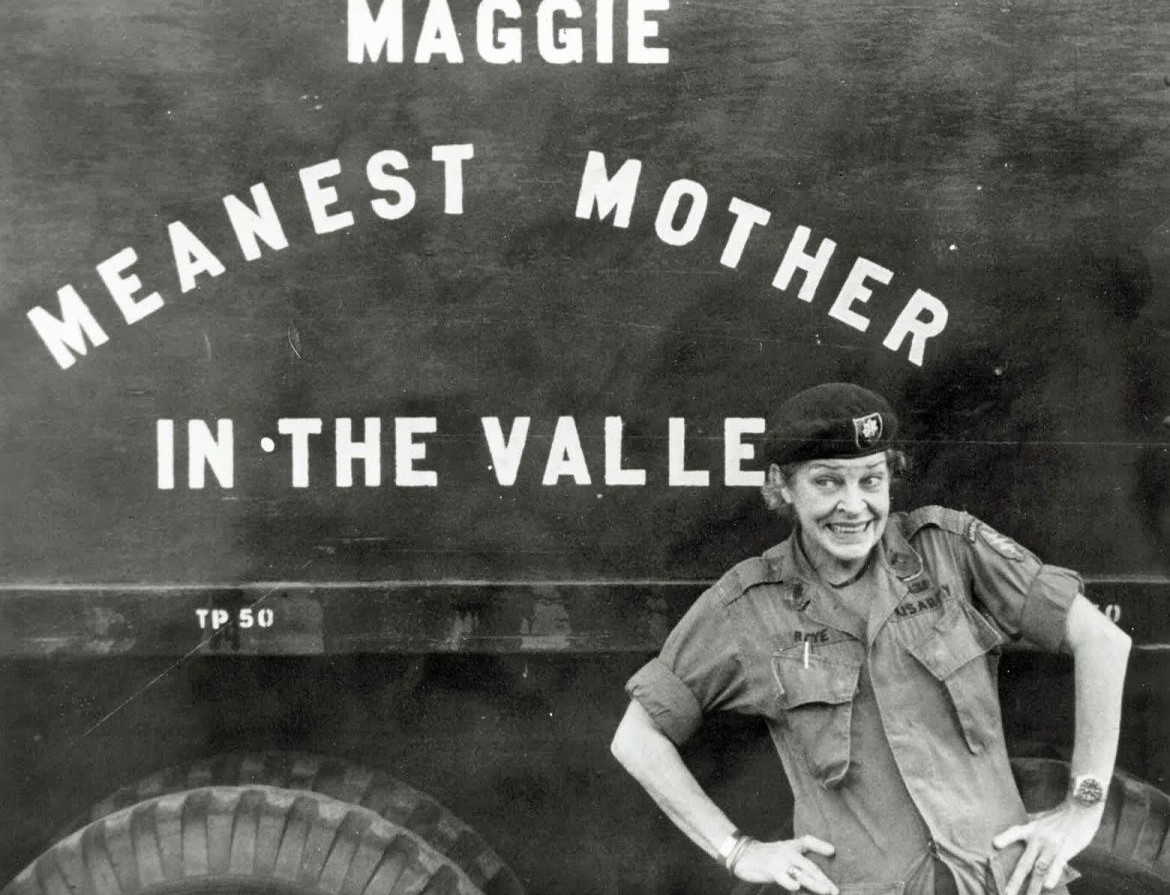
As America entered into World War 2, Raye left Hollywood and joined the USO.  It was the beginning of a lifetime of service in support of the troops that would ultimately define her career.  Throughout World War 2, the Korean War and later Vietnam, Raye went on several tours overseas to entertain the troops, earning the nickname "Colonel Maggie" along the way.  It wasn't always easy on her though, as Raye was deathly afraid of flying.

Between wars, Raye returned to Hollywood and the world of television.  The Martha Raye Show, a variety series, premiered in 1954 and ran for two seasons.  She was cast opposite former boxer Rocky Graziano, playing her boyfriend on the series.  It featured such notable guest stars as Zsa Zsa Gabor and Cesar Romero.

The series was canceled in 1956, at the same time that Raye's marriage to Edward Begley, her fifth husband, ended in divorce.  Coupled with a series of health issues, she attempted to commit suicide on August 14, when she overdosed on sleeping pills.  She survived the attempt however, and spent several weeks recovering at the Sisters of St. Francis Hospital in Miami.  There she was given the Star of David, a St. Christopher's medal and a St. Genesius medal by well wishers.  Although she was a devout Methodist, Raye would wear the amulets faithfully for the rest of her life.  When she returned to television, she would conclude each broadcast with the phrase "goodnight, sisters," as a sign of gratitude.

In 1970, Raye appeared in the Sid and Marty Krofft feature film Pufnstuf, based on their TV series of the same name.  The Kroffts enjoyed working with Raye, and later cast her on their new series The Bugaloos (left), which premiered that fall.  Surely you remember its catchy theme song.

From 1979 to 1984, Raye had a recurring role on the CBS sit-com Alice, playing Carrie Sharples, mother of diner owner Mel Sharples.  During this time period, she also made guest appearances on other popular series of the time, including The Love Boat and Murder, She Wrote.  She also appeared in her final feature film The Concorde...Airport '79, playing a passenger who should not have had that second cup of coffee. 

In 1991, Raye married her seventh and final husband, wannabe celebrity Mark Harris, a man 33 years her junior.  His claim to fame was being a frequent guest on The Howard Stern Show, where he would promote a series of projects that ultimately never went anywhere.  One Stern fan put them all together in a 10-hour clip on YouTube.

By this point, Raye's health was already in decline as she was suffering from Alzheimer's disease.  Then in 1993, doctors removed both of her legs due to poor circulation.  While she was recuperating from this procedure, her home in Los Angeles was destroyed during the Northridge earthquake in January 1994.  Harris moved the couple into a hotel, where she would spend her final days.  She ultimately died of pneumonia on October 19.  She was 78 years old.

As an honorary colonel in both the Army and the Marines, Raye was eligible for burial at Arlington National Cemetery.  Instead, she was buried with full military honors at Fort Bragg in North Carolina, the home of her beloved Special Forces.  She is the only female buried there.

Location: Row 28, Grave 780-B

Rest in peace, Mrs. Sharples.

Trivia

  • Although Raye never published her own memoirs, a number of biographies have been released.  The following are all available from Amazon:
      * Remembering Maggie: WW2 Korea Nam by Robert F. Burgess
      * Martha Raye: Film and Television Clown by David C. Tucker
      * Take it From the Big Mouth: The Life of Martha Raye by
         Jean Maddern Pitrone 

  • Raye was known as "The Big Mouth."  While this typically describes someone who talks too much, in Raye's case it was a literal description.  It would limit her work to supporting, comedic roles, and was often satirized.  The 1937 Warner Brothers cartoon The Woods Are Full of Cuckoos caricatured Raye as a donkey named Moutha Bray.

  • During the 1980s, Raye did a series of commercials for Polident, using the catchphrase "take it from the Big Mouth."  Here's one of the more memorable ones, featuring fellow denture wearers Danny Kaye, Henny Youngman, Scatman Crothers and Yvonne DeCarlo.

  • Not surprisingly, Raye was politically active, supporting the campaigns of both Richard Nixon and Ronald Reagan.  Near the end of her life, she was awarded the Presidential Medal of Freedom by Bill Clinton.

  • Raye has two stars on the Hollywood Walk of Fame - one for motion pictures, the other for television.

  • Shortly before her death, Raye sued Bette Midler and producers of the film For the Boys, claiming it was based on her life experience entertaining the troops during wartime.  The judge ruled however that she didn't have a case.

  • Raye left some of her estate to PETA, but the bulk of it went to her husband Mark Harris.  Ironically, he used his inheritance to design a line of furs.

Tuesday, May 4, 2021

Jack Kevorkian

"Let's hope you feel better now."
  -- Dr. Jack Kevorkian

Murad Jacob "Jack" Kevorkian was born in Pontiac, Michigan on May 26, 1928.  He was the second of three children born to Armenian immigrants.

Kevorkian was a child prodigy.  By age 12, he had taught himself multiple languages, including German, Russian and Japanese.  He skipped the sixth grade entirely and went straight to junior high.

Around the same time, he was beginning to question his family's faith.  His mother had fled her home country following the Armenian Genocide of 1915, and young Jack questioned why God would have allowed such a thing to happen.  He stopped attending regular services with his family and never returned to the church. 

Kevorkian graduated from Pontiac Central High School when he was 17.  He enrolled in the University of Michigan Medical School in Ann Arbor, graduating when he was just 22.  He then completed his residency in anatomical and clinical pathology, while simultaneously conducting his own research on blood transfusion.  Hmmmm.

By 1959, Kevorkian was working at the University of Michigan.  It was here that he first started making headlines for his controversial ideas regarding death.  In an article published in the Journal of Criminal Law, Criminology, and Police Science, Kevorkian wrote "I propose that a prisoner condemned to death by due process of law be allowed to submit, by his own free choice, to medical experimentation under complete anaesthesia....as a form of execution in lieu of conventional methods prescribed by law."  His employers disagreed however, demanding that he recant his proposal.  Kevorkian refused, opting to leave the university instead. 

Kevorkian continued to advocate for experimenting on the condemned.  Following the Supreme Court's decision in Gregg v. Georgia (1976), which re-institutionalized the death penalty, he called for harvesting the organs of death row inmates after the sentence had been carried out.  As before, he failed to gain any public support for his plan.

By this time, Kevorkian was working as a pathologist at Pontiac General Hospital.  There, he continued his blood transfusion research, placing blood from the recently deceased into the currently living.  He thought it had battlefield applications and petitioned the U.S. military to consider his research, but the Pentagon wasn't interested.

Dr. Kevorkian and his Thanatron.
By 1987, Kevorkian was publicly advocating for assisted suicide.  He started placing ads in several Detroit newspapers, offering his services as a "death counselor."  His first client was 54-year-old Janet Adkins, a woman already in the throes of Alzheimer's disease.  With Kevorkian's assistance, she committed suicide in 1990, and the doctor was brought up on charges of murder.  Those charges were ultimately dropped however, as Michigan did not have any laws regarding assisted suicide.  However, the state took away his medical license.

To aid Adkins in her death, Kevorkian constructed a euthanasia device that he called a "Thanatron," from the Greek word thanos, or death.  Once hooked up to the device, Adkins pushed a button that released drugs and chemicals into her system, ultimately ending her life.  The Thanatron proved so successful that Kevorkian later developed another device he called the "Mercitron," or mercy machine.  This version required the user to place a gas mask over their face, one that would deliver carbon monoxide directly into the system.  Between these two devices, Kevorkian allegedly helped 130 terminally ill people shed their mortal coil throughout the 1990s.

During this time period, Kevorkian was tried for assisting suicides no less than four times.  He was acquitted of the first three, while the fourth ended in a mistrial.  All the while, the doctor was gaining publicity and support for the practice of euthanasia.

The doctor received the most exposure on November 22, 1998, during an interview on the CBS program 60 Minutes.  During the segment, viewers saw Kevorkian end the life of 52-year-old Thomas Youk, a man suffering from Lou Gehrig's disease.  Although Kevorkian's patients had always pushed the button themselves, this was the first time in which the doctor had done it for them, in front of millions of viewers no less.  As you can imagine, this would bring the law down on him as never before.  You can view that 60 Minutes piece in its entirety on YouTube.  Viewer discretion is advised.

Just three days after the broadcast, Kevorkian was charged with second-degree murder.  He was also charged with delivery of a controlled substance, given that his license to practice medicine had been revoked.  The trial had a different tone from his earlier three and Kevorkian had less public support than he had before.  It lasted only two days, after which the jury found him guilty (left).  He was sentenced to 10-25 years in prison.

Ultimately, Kevorkian served just eight years at a prison in Coldwater, Michigan.  He was paroled in May 2007 after it was disclosed that he was himself terminally ill.  He was given two years probation and one year to live.  He was also ordered not to kill anyone.

Kevorkian had a history of kidney disease and was diagnosed with cancer of the liver.  He was eventually hospitalized in May 2011 as his condition deteriorated.  Coupled with pneumonia, the cancer ultimately took his life on June 3.  He was 83 years old.  There were no attempts to keep him alive through artificial means and according to all sources, his death was painless.

Dr. Jack Kevorkian was buried in White Chapel Memorial Park Cemetery in Troy, Michigan.

Location: Section H, #6178
Inscription: He Sacrificed Himself for Everyone's Rights

Rest in peace, Dr. Death.

Trivia
  • In 1991, Kevorkian released his book Prescription: Medicide, detailing his beliefs on assisted suicide.  You can pick up a copy from Amazon.

  • Kevorkian was a jazz musician and musical composer.  In 1997, he released his album The Kevorkian Suite: A Very Still Life.  Seriously.  You can listen to it in its entirety on YouTube.

  • The good doctor was also an oil painter, who's work has been described as "grotesque and surreal."  But don't let that stop you from owning a piece for yourself.  Reproductions of his collection are available exclusively from the Ariana Gallery in Royal Oak, Michigan.  

    "Nearer My God to Thee"
    oil on canvas
    Dr. Jack Kevorkian

  • In 2008, Kevorkian launched his bid for the U.S. Congress, running as an Independent candidate in Michigan's 9th Congressional District.  When the votes were tallied, he earned a dismal 2.6 percent. 

  • In 2010, HBO produced a documentary on Kevorkian's life entitled You Don't Know Jack, which featured Al Pacino in the title role.  Check out the trailer on YouTube.

  • Kevorkian's death van is on permanent display at Zak Bagan's Haunted Museum in Las Vegas.  This blogger recommends taking the tour.

Thursday, April 29, 2021

Ethel Merman


"I can hold a note as long as the Chase National Bank."
   -- Ethel Merman

Ethel Merman was born Ethel Agnes Zimmermann in Queens, New York on January 16, 1908.  Her father was an accountant who worked for a dry goods business in Manhattan.  Her mother was a school teacher.  

On Friday nights, the family would go to the Palace Theatre in Manhattan, which was home to the vaudeville stage.  Inspired by the talents of Sophie Tucker, Nora Bayes and Fanny Brice, Merman aspired to be a singer herself.  Although she tried to emulate their singing abilities, it was obvious she had a style all her own.

During her high school years, Merman took secretarial training classes.  Upon graduation, she went to work as a stenographer at the Boyce-Ite Company, makers of fine antifreeze.  She later moved to the Bragg-Kliesrath Corporation, an automobile parts manufacturer, where she served as personal secretary to company president Caleb Bragg.

During this period, Merman began performing in nightclubs and at personal parties.  She was first hired by Lou Clayton, who was a business partner of Jimmy Durante.  As her career began to take off, she opted to shorten her name, believing Zimmermann too lengthy to appear on a theatre marquee.  

Her first theatrical role was in the 1930 film Follow the Leader starring Ed Wynn and Ginger Rogers.  That same year, she was discovered by George and Ira Gershwin, who asked Merman to audition for their new stage musical, Girl Crazy (right).  Upon hearing her rendition of the show's single "I Got Rhythm," the Gershwins signed her on to the show.  It was an overnight success, running for 272 performances.  

In August 1932, Merman signed on to the musical Humpty Dumpty in Pittsburgh.  The show closed in less than a month, but producer Buddy DeSylva was convinced it had commercial appeal.  Following an extensive re-write, it re-opened under the new title Take a Chance, and the audience did just that.  When it re-opened at the Apollo Theatre, it ran for 243 performances and all but made Ethel Merman a household name.

She returned to Hollywood in 1934 and appeared in the comedy We're Not Dressing with Bing Crosby and Carole Lombard.  It was a box office success, but Merman often dismissed the film and director Norman Taurog, whom she blamed for cutting one of her musical performances.

That same year, she returned to Broadway in the Cole Porter musical Anything Goes.  It was a huge success, prompting Hollywood to produce a theatrical version.  Merman was invited to re-create her role on the big screen alongside star Bing Crosby.  Although she had enjoyed the stage production, the film version was a great disappointment to her, as the focus shifted off her character and onto Crosby's, leaving her in more of a supporting role.  Audiences and critics were equally disappointed.

She rebounded nicely however, starring in two of the biggest hits of 1938, Happy Landing (left) and Alexander's Ragtime Band.  The films would be the highlight of her 1938, as her marriage to agent William Smith that year would end in divorce just two months later.  Strike one!

In 1939, she walked down the aisle once again, this time marrying Robert D. Levitt, a New York City promotional director.  Although the couple had two children, this marriage would also end in divorce, but not until 1952.  Strike two!

In 1946, Merman headlined the Broadway musical Annie Get Your Gun, one of her most successful performances yet.  It ran for three years and 1,147 performances.  Despite this, Merman was not cast in the theatrical version, as her role went to Wizard of Oz star Judy Garland.

With a string of successful productions under her belt, Merman decided to relax and focus on her personal life.  In 1953, she married Robert Six, an executive with Continental Airlines.  They settled in Colorado and Merman assumed a new role, that of suburban housewife.  It didn't sit well with Six however, who had expected her appearances to generate publicity for the airline.  He encouraged her to return to the stage, so she accepted the lead in the Broadway musical Happy Hunting.  Although it was a modest success, Merman was reportedly disappointed with the production and frequently clashed with its producers.  It closed after 412 shows, which Merman described as "a dreary obligation."  The best was yet to come.

In 1959, Merman began her most remembered performance, that of Rose Hovick in the musical Gypsy (right).  It ran for 702 performances, earning Merman critical praise, both for her singing and acting abilities.  Despite this, she was once again passed over by Hollywood, when Rosalind Russell was cast in the film adaptation.  Additionally, Merman lost the Tony Award for best actress to her friend Mary Martin, who took home the trophy for her performance in The Sound of Music.  Merman later famously quipped "how are you going to buck a nun?"

During the run of Gypsy, Merman filed for divorce from Six after learning of his affair with Honeymooners star Audrey Meadows.  Strike three!

In 1963, Merman joined the ensemble cast of one of her best-remembered films, It's a Mad, Mad, Mad, Mad World (below).  It was something of a departure for her career, since the film was not a musical and relied solely on her acting abilities.  Those who've seen it know she played the part of the nagging mother-in-law to perfection.  It was a huge box office success, taking in nearly six times it's production budget.

Merman continued acting on stage throughout the 60s, and turned up on many popular television series as well, including The Carol Burnett Show, The Lucy Show and That Girl.  She was also a frequent panelist on the game show Match Game, a show perfectly suited for her bawdy sense of humor.  And although not a series highlight, this blogger probably first saw Merman on the Adam West Batman series, playing special guest villain Lola Lasagna.

In 1980, Merman made her final appearance on the big screen, a cameo performance in the comedy hit Airplane!, wherein she sang her signature song "Everything's Coming Up Roses."

In 1983, Merman's health began to decline.  She was diagnosed with stage 4 glioblastoma and underwent brain surgery to have the tumor removed.  It turned out to be inoperable however, and Merman was given less than a year to live.  She eventually passed on February 15, 1984.  She was 76 years old.

Now this is where it gets interesting. Merman has a family tomb at the Shrine of Remembrance Mausoleum in Colorado Springs, Colorado (below).  According to an employee who this blogger spoke to, Merman's ashes may or may not be stored there.  Some believe that her ashes remain with her surviving family members, to be interred in Colorado at a later date.


Rest in peace, Lieutenant Hurwitz.

Trivia

  • Although born in 1908, Merman would often cite her birth year as 1912.

  • Merman published two personal memoirs, Who Could Ask for Anything More? (1955) and Merman (1978).  Both are available from Amazon. 

  • Merman sang her hit song "Everything's Coming Up Roses" at two presidential inaugurations, first for John F. Kennedy in 1961, then for Ronald Reagan in 1981.  In her personal life, she was a lifelong republican and frequent guest at the Eisenhower White House.

  • Merman kept her Christmas tree up year round.  Purportedly this was due to her love of the holiday.  Right.

  • Merman has not one but two stars on the Hollywood Walk of Fame, one for her singing abilities, the other for her roles in television and films.

  • In 1963, The U.S. Postal Service introduced ZIP codes (Zoning Improvement Plan) in an effort to make mail delivery more efficient.  No really.  Merman was hired to be the voice of a new PR campaign, singing a catchy jingle.  You can hear a clip of it here.  She comes in at the 1:50 mark.

Friday, April 23, 2021

Estelle Getty


"If there are two things in life you want to do and one of them is acting...do the other."
  -- Estelle Getty

Estelle Getty was born Estelle Scher in New York City on July 25, 1923.  Her parents were Jewish immigrants from Poland who settled on the Lower East Side, where her father operated an automobile glass business, fixing windshields in cars and trucks.

As a young girl, she spent her Friday nights with her family at the Academy of Music in lower Manhattan, which was home to the vaudeville stage and a movie house.  These performances inspired her into becoming an actress herself.

After graduating from high school, she took a job as a secretary while attending auditions at night.  She often found work in the New York theater district, but success and stardom were still years away.  

In 1947, she married Arthur Gettleman, from whom she would later adopt her stage name of Getty.  He went to work for her father in the glass business and continued running it for the next five decades.  They raised two boys together, while she continued taking theatrical roles.  Her big break however, didn't come until 1982, when she was cast in a Broadway production of Torch Song Trilogy, in a role that playwright Harvey Fierstein created just for her. 

The play was an overnight success and Getty earned widespread acclaim for her performance.  She continued in the role for the next three years, both on Broadway and off.  It was because of this role that she came to the attention of executives at Witt/Thomas/Harris Productions in Los Angeles, who were casting a new sit-com for the Fall 1985 season, one that featured four senior citizens sharing a condo in Miami.  That year, Getty was cast as Sophia Petrillo on The Golden Girls, the role that would define her career.

The series lasted for seven seasons and Getty proved to be the breakout star.  In 1988, she won an Emmy Award as Outstanding Supporting Actress in a Comedy Series.  The character proved so popular that NBC farmed her out to its other sit-coms, and Sophia found herself visiting the casts of Empty Nest, Nurses and Blossom.  Sadly, she never visited that bar where everybody knows your name.

The series came to an end in 1992, when lead actress Bea Arthur opted to pursue other projects.  Rival network CBS convinced Getty, Rue McClanahan and Betty White to continue their roles in a series dubbed The Golden Palace.  It would only last for one season however, as it was obvious that the magic was gone.  The series is notable for introducing audiences to supporting actor Don Cheadle, who has since gone on to find great success at the box office.

When that series ended, Getty continued acting on television, guest starring on such series as The Nanny and Mad About You.  Her roles were often thinly veiled replicas of her Sophia character, which I'm sure delighted Golden Girls fans.  She also appeared in a few feature films, including Stuart Little and the Sylvester Stallone action comedy Stop! Or My Mom Will Shoot, for which she was honored with a Razzie Award for Worst Supporting Actress.

By the early 2000s, Getty's health had started to decline, and according to her Golden Girls co-stars, she was no longer able to recognize them or hold conversations with them.  She was ultimately diagnosed with dementia, from which she passed away on July 22, 2008, just three days shy of her 85th birthday.

Estelle Getty was buried at Hollywood Forever Cemetery in Los Angeles.  Arthur passed in 2004 and was cremated.  The location of his ashes remains unknown.

A rare shot of this blogger.  Although you can't see it in the photo,
the grave of voice actor Mel Blanc is directly behind me.

Thank you for being our friend, Estelle.

Trivia

  • Although she played Bea Arthur's mother on television, Getty was more than a year younger than her.  

  • Getty released a book of her wit and wisdom in 1988.  You can pick up a copy of If I Knew Then What I Know Now....So What from Amazon.

  • Getty released an exercise video for seniors in 1993.  You can watch Young at Heart: Body Conditioning with Estelle in its entirety on YouTube.  I highly recommend it.

  • Getty was politically active, once stating "the only time you'll see me as a democrat is when I play Sophia.  In the real world I'm a republican from head to toe."  She was especially active on the issue of AIDS, caring for her 29-year-old nephew as he died from the disease.  She later started a charity for AIDS research.

  • In September 1999, this blogger attended a taping of Wheel of Fortune at the Sony Pictures Studios in Los Angeles.  Sitting in the audience not too far away was Ms. Getty herself, who was introduced to the rest of us by announcer Charlie O'Donnell.  She explained that she was on the lot that day filming a movie and decided to stop by and see her favorite game show live and in person.

Monday, April 19, 2021

Charles Bronson


"Some day I'd like a part where I can lean my elbow against a mantlepiece and have a cocktail."
  -- Charles Bronson

Charles Bronson was born Charles Dennis Buchinsky in Ehrenfeld, Pennsylvania on November 3, 1921.  He was the 11th of 15 children and was of Lithuanian ancestry.  His father, born Valteris Bucinskis, immigrated to the U.S. and changed his name to Walter Buchinsky as it sounded more American.  He settled in Pennsylvania, where he met Mary Valinsky, who was also of Lithuanian heritage.  The two married and settled in the coal mining town of Tamaqua.

When Bronson was just ten years old, his father died unexpectedly.  It couldn't have come at a worse time, as America was already in the throes of the Great Depression.  So when he turned 16, he put school on the back burner and joined his brothers in the mines, earning $1 for every ton of coal he produced.  He stuck with it until 1943, when he was drafted into the Army and assigned to the Air Corps.  He served as a tail gunner aboard a B-29 bomber and flew 25 missions, earning the Purple Heart.

After the war, Bronson joined a theatrical group in Philadelphia and worked a series of odd jobs.  He made his way to New York City, intent on making it on the Broadway stage.  But by 1950, Hollywood was calling, so Bronson headed west and started finding small roles.

His first role was as a sailor in the 1951 film You're in the Navy Now.  He'd follow it up with roles in House of Wax (1953) and Apache (1954).  He was also making early appearances on television, on a bunch of series that you've probably never heard of.  Two that completely astound this blogger are the crime drama Biff Baker, USA, which starred the Skipper himself, Alan Hale, Jr., and Knockout, a boxing show hosted by Roy Rogers.  Bronson and Rogers even squared off against each other in the ring (above).

Now I've been referring to him as Bronson herein, but he didn't take that name until 1954 at the height of the Red Scare and the McCarthy hearings.  On advice of his agent, he changed his named from Charles Buchinsky to something that sounded a little more American, just as his father had done years earlier.  He took the name Bronson from the Bronson Gate at Paramount Studios.  

New name in tow, Bronson headlined a detective series on ABC called Man With a Camera.  He moved from there to a series of low-budget films, including Machine Gun Kelly (1958) and Showdown at Boot Hill (1959).  He was still taking roles on television though, most memorably on The Twilight Zone ("Two," with Elizabeth Montgomery) and a recurring role on Have Gun - Will Travel.


Bronson's first major role, the one would make him a household name, was in the 1960 film The Magnificent Seven.  He was paid $50,000 for the role and according to co-star Eli Wallach, Bronson was a loner who kept to himself throughout production.  But director John Sturges was impressed enough to cast Bronson in his next blockbuster The Great Escape (1963).  For this role, Bronson had to conquer his claustrophobia, developed from his childhood years spent in the mines, to play a Polish prisoner of war tunneling his way out.

His next major role was in the 1967 film The Dirty Dozen.  Although the film was a box office success, Bronson was only third billed.  Seeking more starring roles, he left for Europe, where he worked regularly for the next five years, starring in such features as Once Upon a Time in the West (1968), You Can't Win 'Em All (1970) and Rider on the Rain (1970).  Note: If you click on only one link in this whole blog post, make it Rider on the Rain.  It does not disappoint.

It was during this period that he married British actress Jill Ireland.  The two were introduced by their mutual friend David McCallum, who coincidentally, was Ireland's husband at the time.  Bronson famously told McCallum "I'm going to marry your wife."  I like a man who keeps his word.

Bronson returned to the U.S. in 1972.  It was a smart move, as he was cast in the role that would define his career, that of Paul Kersey in Death Wish (1974).  The story sees Bronson as a successful New York City architect who turns into a vigilante after his wife is murdered and his daughter is assaulted.  The movie was so successful that it spawned four sequels, all of diminishing quality.  But you gotta love the title Death Wish 4: The Crackdown. 

In 1990, Ireland lost her battle with cancer.  By then, she and Bronson were living in Vermont, and he had her interred at Brownsville Cemetery in West Windsor.  He continued acting throughout the 1990s in a series of films that you've probably never heard of.

Then in 1998, Bronson had hip replacement surgery.  It marked the end of his career as he was no longer able to perform the action sequences that had defined him.  He officially retired from acting and began to focus on his health.  But his years of smoking finally caught up with him, and he died of lung cancer on August 30, 2003.  He was 81 years old.

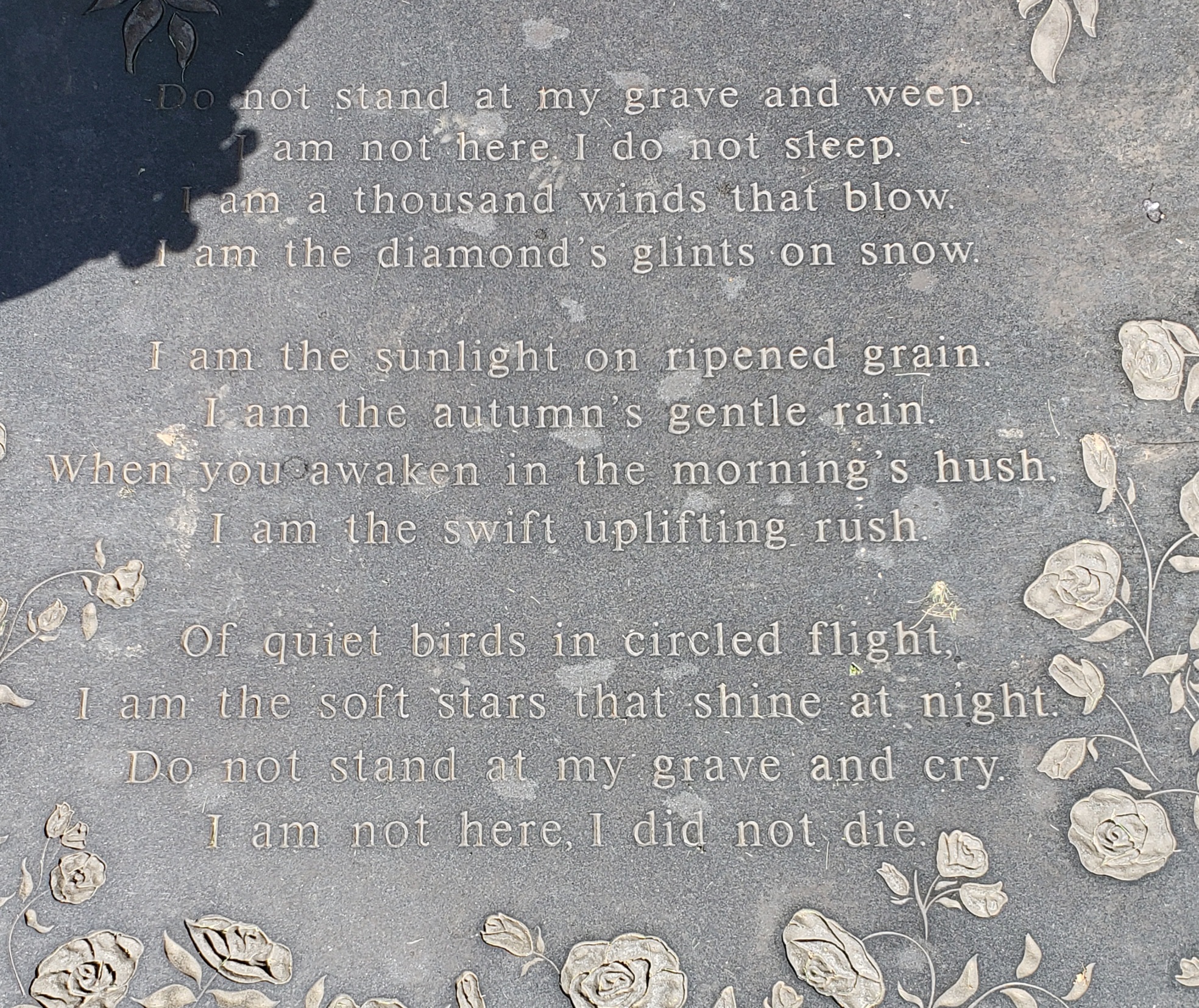
He was buried with Jill at Brownsville Cemetery.  It's a very elaborate and expensive marker.  Despite that, only his name appears on it.  Though unconfirmed, I suspect the children from his first marriage didn't care much for Jill.


Rest in peace.

Trivia

  • Bronson's life was chronicled in the biography American Legends: The Life of Charles Bronson by the Charles River Editors.  Pick up a copy from Amazon.

  • The poem on Bronson's marker was written by poet Mary Elizabeth Frye in 1932.  It wouldn't gain popularity until 1979, when it was used in an NBC movie of the week called Better Late Than Never.  Neither Bronson nor Ireland appeared in the film.

  • As a young actor in the 1940s, Bronson shared a New York City boarding house with Jack Klugman, who was also yet to be discovered.  I wonder which one was the slob.

  • Bronson was considered for but not offered the lead role in Superman (1978), Escape From New York (1981), Conan the Barbarian (1982) and Die Hard (1988).  He was offered the role of the Man With No Name in A Fistful of Dollars (1964) but passed, believing it to be a bad script.  The role went to Clint Eastwood, and the film was a box office success spawning two sequels.  He was also offered the role of Adam Sandler's father in Billy Madison (1995) but turned it down.  The role went to Darren McGavin.

  • Bronson had a lot of fans, one of whom took it a little too seriously.  When she passed away in the 1990s, she left her estate (worth over $1 million) to the actor, whom she had never even met. Her family sued Bronson and the two parties settled out of court.